
Soy vs. Dairy: A Comprehensive Carbon Footprint Analysis
An in-depth investigation into the environmental life cycle, greenhouse gas emissions, and resource intensity of the world’s most popular milks.
Table of Contents
- 1. Introduction: The Global Shift in Consumption
- 2. The Heavy Burden of Dairy Production
- 3. The Lifecycle of Soy Milk: A Carbon Perspective
- 4. Head-to-Head: CO2e per Liter
- 5. Beyond Carbon: Land and Water Usage
- 6. The Deforestation Myth and Realities
- 7. Processing and Transportation Logistics
- 8. Making Sustainable Decisions
- 9. Frequently Asked Questions (Schema)
1. Introduction: The Global Shift in Consumption
The conversation surrounding dietary choices has shifted significantly over the last decade. While flavor and nutrition remain paramount, the environmental impact of what we put in our shopping carts has become a critical deciding factor for millions of consumers. Central to this debate is the comparison between soy milk and traditional dairy milk. As the climate crisis intensifies, understanding the carbon footprint of these products is no longer just a matter of academic interest—it is a necessity for responsible living.
Carbon footprinting measures the total greenhouse gas emissions (GHG) caused by an individual, event, organization, or product, expressed as carbon dioxide equivalent (CO2e). When we analyze milk, we must look at the entire lifecycle, from the birth of a calf or the planting of a seed to the moment the carton is disposed of. This analysis explores the intricate data behind these two staples, evaluating how they contribute to global warming and resource depletion.
2. The Heavy Burden of Dairy Production
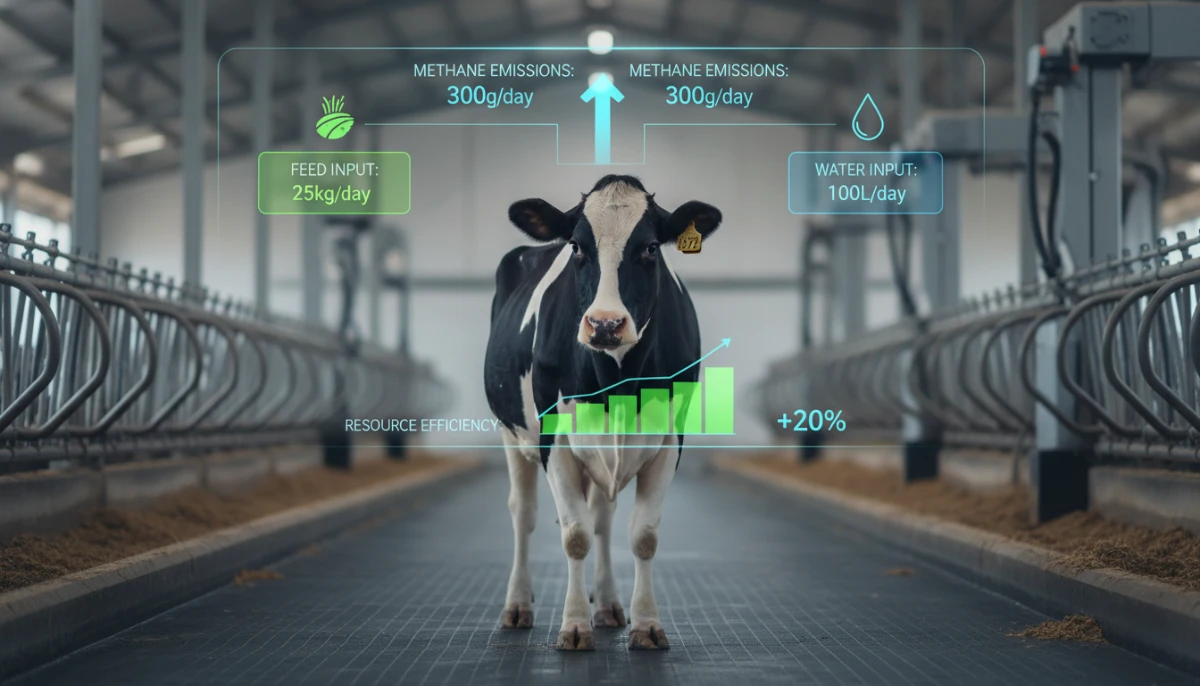
Dairy milk production is a resource-intensive process that begins with livestock. The primary driver of dairy’s high carbon footprint is enteric fermentation—a natural digestive process in ruminant animals like cows that produces methane (CH4). Methane is a potent greenhouse gas, with a global warming potential more than 25 times that of CO2 over a 100-year period.
Enteric Fermentation and Manure Management
Beyond methane from digestion, manure management also contributes significantly to a farm’s emissions profile. When manure is stored in large lagoons, it releases both methane and nitrous oxide (N2O), the latter being nearly 300 times as potent as CO2. These biological processes are inherent to animal agriculture and represent a significant hurdle for the dairy industry’s decarbonization efforts.
Feed Production and Fertilizer
Cows require vast amounts of feed, including corn, alfalfa, and often soy. The production of this feed requires large tracts of land and heavy applications of synthetic fertilizers. The manufacturing of these fertilizers is energy-intensive, and their application leads to further nitrous oxide emissions from the soil. In essence, the carbon footprint of dairy is amplified because we must first grow crops to feed the animals that eventually produce the milk.
3. The Lifecycle of Soy Milk: A Carbon Perspective
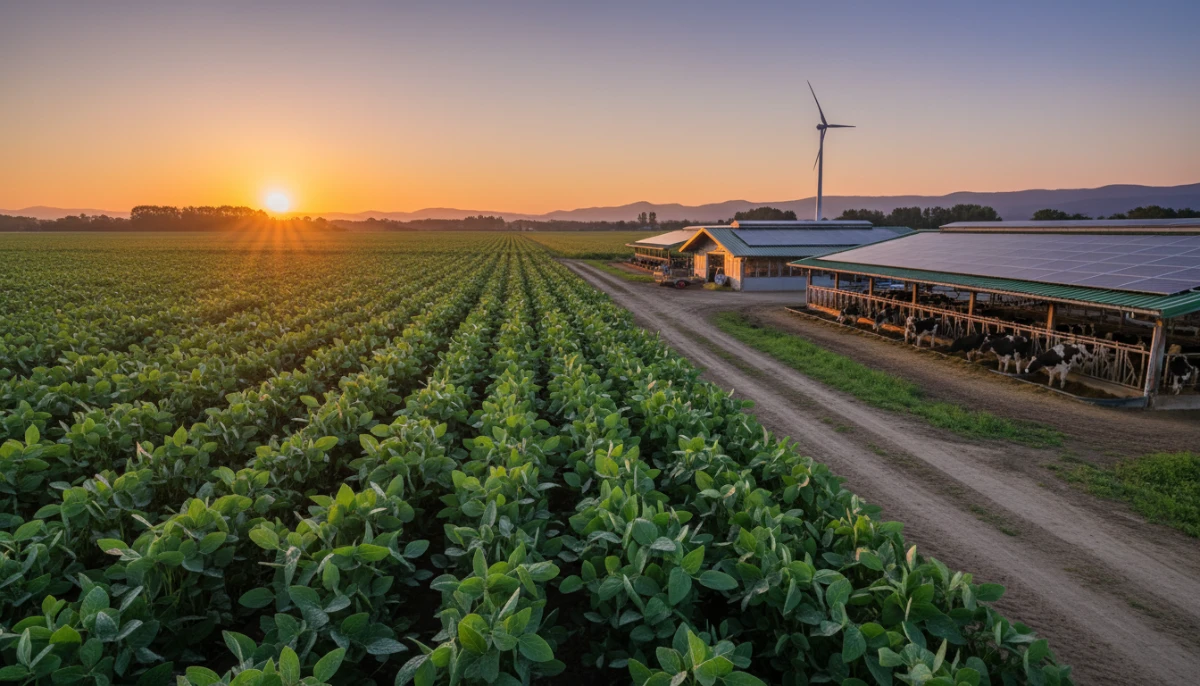
Soy milk is often touted as a more sustainable alternative, but it is not without its own environmental costs. However, the lifecycle of a soybean is fundamentally different from that of a dairy cow. As a legume, soybeans have the unique ability to fix nitrogen from the atmosphere, which significantly reduces the need for synthetic nitrogen fertilizers—one of the largest contributors to agricultural carbon emissions.
Cultivation and Harvesting
The cultivation of soy involves land preparation, planting, and mechanical harvesting. Each of these steps requires fuel for machinery. While this contributes to the carbon footprint, it is relatively minor compared to the biological emissions of livestock. The primary environmental concern for soy is not the plant itself, but where it is grown—specifically in relation to deforestation in regions like the Amazon.
Processing Soy into Milk
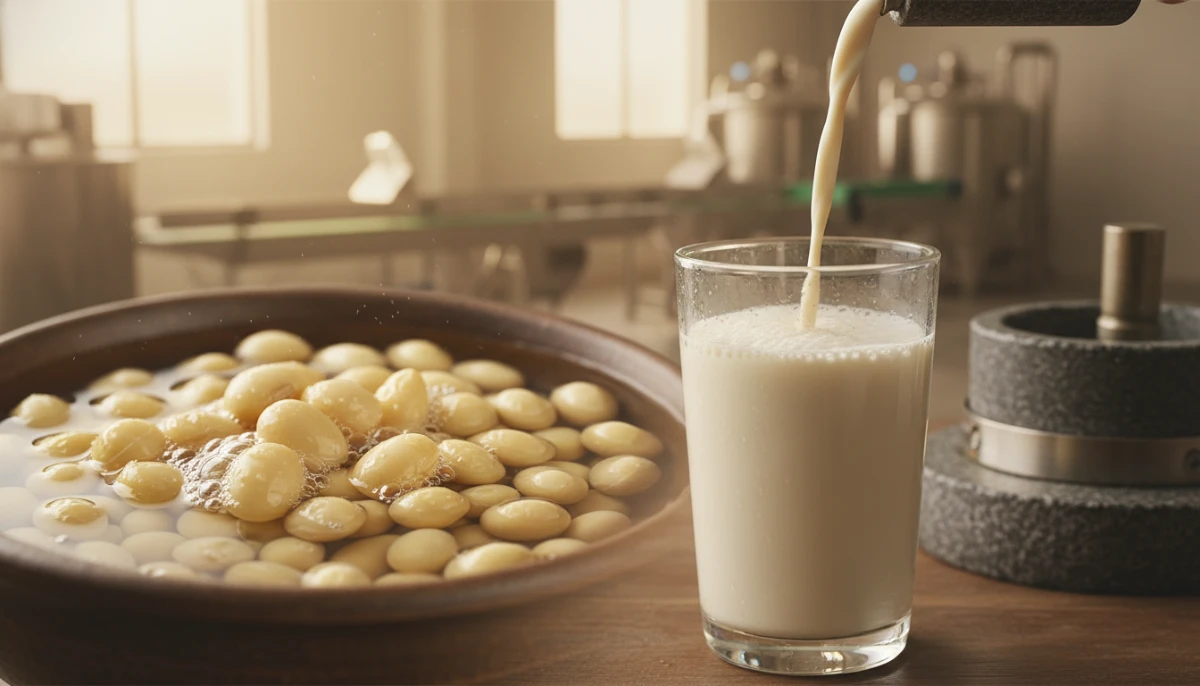
Once harvested, soybeans must be cleaned, soaked, ground, and filtered to create milk. This processing requires electricity and heat (usually from natural gas). Despite these energy requirements, the total emissions remain significantly lower than dairy because the ‘biological factory’ ( the plant) is far more efficient than the animal model.
4. Head-to-Head: CO2e per Liter
When we look at the hard data from peer-reviewed studies, such as the comprehensive meta-analysis by Poore and Nemecek (2018), the difference is stark. On average, the production of one liter of dairy milk results in approximately 3.2 kilograms of CO2e. In contrast, one liter of soy milk results in roughly 0.7 kilograms of CO2e.
Dairy Milk
3.2kg
CO2e per Liter
Soy Milk
0.7kg
CO2e per Liter
This nearly five-fold difference is primarily due to the trophic level efficiency. When humans consume soy milk, we are eating ‘lower’ on the food chain. We bypass the inefficient process of converting plant calories into animal calories, which involves significant energy loss and greenhouse gas production.
5. Beyond Carbon: Land and Water Usage
While carbon is the primary metric for climate change, land and water use are equally vital for planetary health. Dairy requires roughly 10 times more land than soy milk. For every liter of dairy milk produced, approximately 8.9 square meters of land are used annually. Soy milk requires less than 1 square meter.
Water consumption follows a similar trend. Dairy is notoriously thirsty, requiring roughly 628 liters of water per liter of milk (accounting for cow hydration and crop irrigation). Soy milk requires approximately 28 liters per liter. This discrepancy is particularly critical in drought-prone regions where water scarcity is a growing threat to food security.
6. The Deforestation Myth and Realities
A common argument against soy milk is its link to deforestation in the Amazon rainforest. While it is true that soy expansion is a major driver of habitat loss, it is crucial to understand the destination of that soy. Approximately 75% to 80% of global soy is used as animal feed, primarily for poultry, pigs, and dairy cows. Only a small fraction (about 6%) is used for human food products like tofu and soy milk.
Ironically, consuming dairy milk often contributes more to soy-driven deforestation than drinking soy milk does, because the cow requires a much larger volume of soy throughout its life to produce a relatively small volume of milk. Most soy milk manufacturers in the US and Europe source their beans from domestic farms or Canada, where deforestation is not a primary concern.
7. Processing and Transportation Logistics
The ‘food miles’ argument—the idea that local is always better—often complicates the carbon footprint discussion. However, studies show that for most food products, transportation accounts for less than 10% of total emissions. The production method (the ‘how’) is far more important than the location (the ‘where’).
Dairy milk is highly perishable and heavy, requiring refrigerated transport and constant cooling, which adds to its carbon footprint. Soy milk can often be processed into shelf-stable (aseptic) packaging, allowing for more efficient ambient shipping and reduced food waste. This logistical advantage further tilts the environmental scales in favor of soy.
8. Making Sustainable Decisions
Choosing between soy and dairy is not just an environmental decision but a nutritional one. Soy milk is one of the few plant milks that provides a protein profile comparable to dairy. For consumers looking to reduce their carbon footprint without sacrificing nutrition, soy is often the most balanced choice.
To maximize sustainability, consumers should look for:
- Organic certification to ensure no synthetic pesticides or fertilizers were used.
- Non-GMO labels (though soy milk is rarely made from the GMO soy used for livestock).
- Brands that utilize renewable energy in their processing facilities.
- Recyclable or FSC-certified packaging.

9. Frequently Asked Questions
Is soy milk better for the environment than dairy?
Yes. From a carbon, land, and water perspective, soy milk has a significantly lower environmental impact than dairy milk, producing about 75% fewer greenhouse gas emissions.
Does soy milk cause deforestation?
While soy production is linked to deforestation, the vast majority of that soy is grown for animal feed. Most soy milk for human consumption is sourced from sustainably managed farms in North America and Europe.
What about the carbon footprint of almond milk vs. soy?
Both have lower carbon footprints than dairy, but soy generally requires less water than almond milk, making it a slightly more sustainable all-around option in water-scarce areas.