
The Comprehensive Guide to Soy Milk Manufacturing: Science, Process, and Additives
A technical exploration into the industrial scale production of plant-based protein beverages, focusing on quality control and functional formulation.
Table of Contents
The Evolution of Soy Milk Production
Soy milk, a nutrient-dense extract of the Glycine max (soybean) legume, has transitioned from a traditional artisanal beverage in East Asia to a global industrial commodity. The manufacturing process today is a sophisticated blend of mechanical engineering, food chemistry, and microbiology. Understanding how soy milk is manufactured requires looking beyond the simple soaking of beans; it involves high-pressure homogenization, precise thermal kinetics, and the strategic use of additives in soy milk to ensure a product that mirrors the sensory experience of bovine milk while maintaining a clean label profile.

The global demand for plant-based alternatives is driven by diverse factors, including lactose intolerance, veganism, and environmental sustainability. For manufacturers, the challenge lies in creating a stable emulsion that does not separate over time. Soybeans are naturally rich in proteins and fats, but extracting these components efficiently while neutralizing the ‘beany’ flavor profile—caused by the enzyme lipoxygenase—is the primary technical hurdle in any soy milk manufacturing line.
Raw Material Selection and Quality Standards
The quality of the final beverage is fundamentally determined by the quality of the soybeans. Manufacturers typically seek non-GMO (Genetically Modified Organism) varieties with high protein content and low hilum color to ensure a bright, creamy appearance. Soybeans must be thoroughly cleaned to remove extraneous matter such as stones, dust, and damaged seeds which can harbor microorganisms and introduce off-flavors.
Protein Profile
The glycinin and beta-conglycinin ratios are critical for the gelation and emulsification properties of the milk.
Moisture Content
Standardized at approximately 12% to prevent mold growth during storage before processing begins.
Lipid Stability
Monitoring free fatty acids ensures the final product avoids rancidity during its shelf life.
The Industrial Manufacturing Workflow
1. Cleaning and Dehulling
Modern facilities utilize vacuum-assisted cleaning and abrasive dehulling systems. Removing the outer hull (seed coat) is vital because it contains the majority of the indigestible oligosaccharides and bitter compounds. Dehulling also reduces the microbial load, as the hull is the primary contact point for environmental contaminants.
2. Thermal Inactivation
To eliminate the ‘beany’ taste, the beans are subjected to a ‘blanching’ process. This involves heating the beans to approximately 80-90 degrees Celsius for a short duration. This specific temperature range is calibrated to denature lipoxygenase enzymes without causing excessive protein denaturation, which would lower the extraction yield.
3. Grinding and Extraction
The beans are ground with water (usually in a 1:8 or 1:10 ratio) using stone mills or high-speed rotary cutters. This creates a slurry. The temperature of the water during grinding is meticulously controlled; using hot water helps in the further inactivation of enzymes and improves the solubility of the proteins.
4. Separation (Centrifugation)
The slurry is passed through a decanter centrifuge to separate the insoluble fiber—known as okara—from the liquid extract. The okara is a byproduct often used for animal feed or further processed into food ingredients, while the liquid is the ‘raw’ soy milk ready for formulation.

Deep Dive: Additives in Soy Milk
While the core of soy milk is simply soybeans and water, the commercial viability of the product relies heavily on the strategic application of additives. The role of additives in soy milk is multifaceted: they improve texture, ensure nutritional equivalence to dairy, and maintain stability during long-term storage. Without these components, the beverage would quickly sediment, separate, and lack the creamy mouthfeel consumers expect.
Emulsifiers and Stabilizers
The most common additives in soy milk for texture management are Lecithin and Gellan Gum. Lecithin, often derived from soy itself, acts as an emulsifier that bridges the gap between water and the natural fats in the milk. Stabilizers like Carrageenan or Guar Gum create a weak gel network within the liquid. This network is strong enough to keep calcium and other solids in suspension but fluid enough to pour easily. Modern clean-label movements have seen a shift toward Gellan Gum due to its efficiency at very low concentrations.
Nutritional Fortification
To compete with bovine milk, soy milk is often fortified with Calcium Carbonate or Tricalcium Phosphate. These minerals are not naturally soluble in water, which is why the aforementioned stabilizers are critical. Vitamins A, D, and B12 are also standard additives, ensuring that vegans and those with dairy allergies do not miss out on essential micronutrients. These are usually added as a ‘pre-mix’ during the formulation stage after centrifugation.
Acidity Regulators
Soy milk is naturally slightly acidic. When added to coffee, which is also acidic, the proteins in the soy milk can reach their isoelectric point and coagulate (curdle). To prevent this, manufacturers use acidity regulators like Dipotassium Phosphate or Sodium Citrate. These additives buffer the pH, making the soy milk ‘barista friendly‘ and stable in high-acid environments.
Sweeteners and Flavoring
Unsweetened soy milk has a distinct profile that may not appeal to all palettes. Additives such as cane sugar, agave syrup, or natural vanilla extracts are used to enhance the flavor profile. In ‘Original’ versions, a small amount of sea salt is often added to brighten the flavor and mask any lingering earthiness from the beans.
The Regulatory Landscape of Additives
In the European Union and the United States, all additives in soy milk must undergo rigorous safety evaluations by the EFSA or FDA, respectively. These substances are assigned E-numbers or are classified as GRAS (Generally Recognized As Safe). Manufacturers must list every additive on the ingredient label, allowing consumers to make informed choices. Recent trends show a move toward ‘clean label’ formulations, where companies attempt to achieve stability through mechanical means (like higher pressure homogenization) rather than chemical stabilizers.

Homogenization and Thermal Processing
After the additives in soy milk have been thoroughly blended, the mixture undergoes High-Pressure Homogenization (HPH). This is a critical mechanical step where the liquid is forced through a tiny valve at pressures up to 200-500 bar. This process breaks down fat globules and protein aggregates to a sub-micron size. Smaller particles have a lower rate of sedimentation (as per Stokes’ Law), which results in a significantly smoother texture and improved shelf stability.
UHT: Ultra-High Temperature Treatment
To ensure the product is shelf-stable without refrigeration, it must be commercially sterile. The most common method is UHT processing, where the milk is heated to 135-150 degrees Celsius for just 2 to 5 seconds. This rapid heating and cooling cycle kills all pathogenic bacteria and heat-resistant spores while preserving the majority of the vitamins and the nutritional profile. The speed of the process is essential to avoid the ‘cooked’ flavor that occurs with traditional pasteurization.
- Direct Steam Injection: Provides the fastest heating but requires water removal.
- Indirect Heating: Uses plate or tubular heat exchangers for better energy efficiency.
- De-aeration: A vacuum process to remove dissolved oxygen, preventing oxidation of lipids during storage.
Quality Assurance and E-E-A-T Principles
Establishing Trust (T) and Expertise (E) in soy milk manufacturing involves strict adherence to international safety standards. HACCP (Hazard Analysis and Critical Control Points) and ISO 22000 are the benchmarks for any credible facility. Quality assurance teams monitor critical points such as the final pH, viscosity, and particle size distribution. Sensory panels are also employed to ensure that the flavor profile remains consistent across different batches of soybeans, which can vary by season and origin.
Environmental stewardship is also becoming a pillar of authority in the industry. Measuring the ‘water footprint’ and ‘carbon footprint’ of the manufacturing process allows brands to substantiate their sustainability claims. Soy milk generally requires significantly less land and water than dairy milk, but the energy-intensive UHT and homogenization processes are areas where manufacturers are looking to implement green technologies like heat recovery systems.
Aseptic Packaging and Shelf Stability
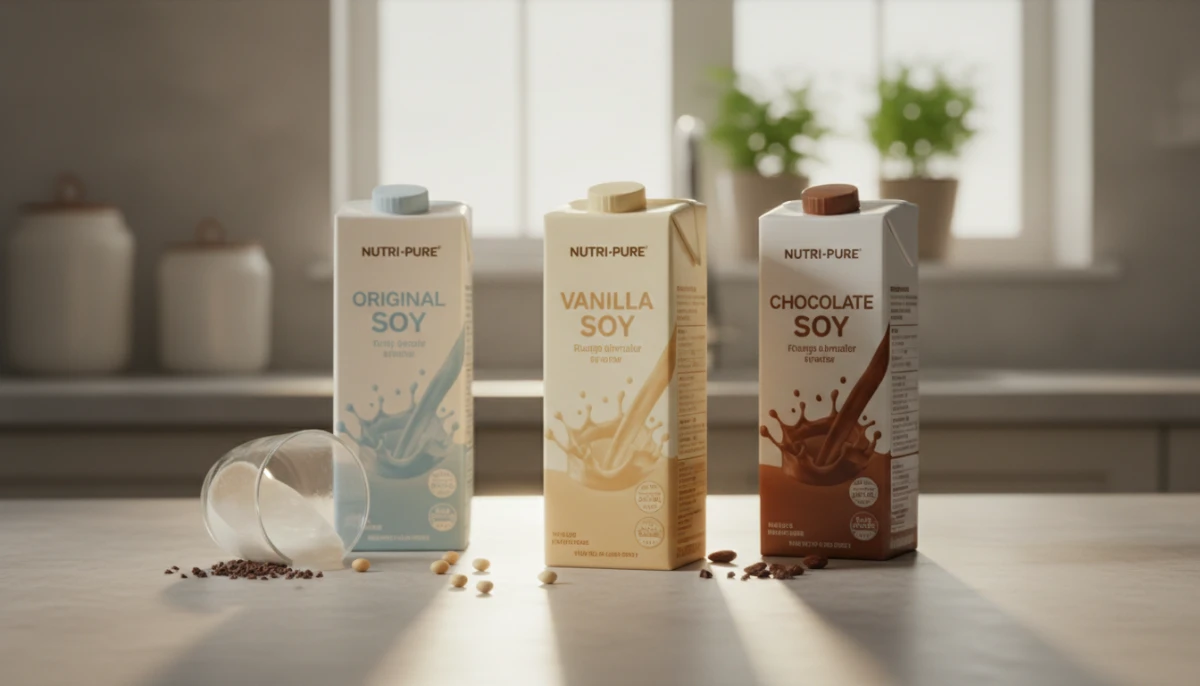
The final stage of the manufacturing process is aseptic packaging. This occurs in a sterile environment where the sterilized soy milk is filled into pre-sterilized containers (usually multi-layered Tetrapak cartons). These cartons consist of layers of paperboard, polyethylene, and aluminum foil. The aluminum layer is particularly important as it acts as a barrier against light and oxygen, which are the primary catalysts for nutrient degradation and off-flavors. Once sealed, UHT soy milk can remain shelf-stable for 6 to 12 months without the need for preservatives, provided the package remains unopened.
Frequently Asked Questions
Why are additives in soy milk necessary?
Additives like stabilizers and emulsifiers prevent the natural separation of solids and fats. Acidity regulators prevent curdling in hot coffee, and fortification ensures the milk provides essential nutrients like calcium and Vitamin D.
What is the difference between soy milk and soy drink?
In many regions, including the EU, the term ‘milk’ is legally reserved for mammary secretions. Products derived from plants must be labeled as ‘drinks’ or ‘beverages,’ though the manufacturing process remains the same.
Is carrageenan in soy milk safe?
Food-grade carrageenan is approved by regulatory bodies like the FDA and EFSA. However, due to consumer concerns regarding digestive sensitivity, many manufacturers are now replacing it with Gellan Gum or other alternatives.
How does homogenization affect the quality of soy milk?
Homogenization breaks down particles to a very small size, which creates a creamy texture, prevents a ‘gritty’ mouthfeel, and ensures that the added minerals like calcium remain suspended throughout the liquid.